

When Marketing Starts to Break Down
Your team is running campaigns across email, paid ads, and social media. Leads are coming in, but no one is quite sure what happens next. Reporting takes hours (or days), and every tool seems to tell a different story.
Do these sound familiar?
- Leads are generated… but not followed up
- Data exists… but insights don’t
- Campaigns run… but ROI is unclear
At some point, marketing doesn’t just need more effort, it needs better systems.
That’s where a martech stack comes in.
What Is a Martech Stack?
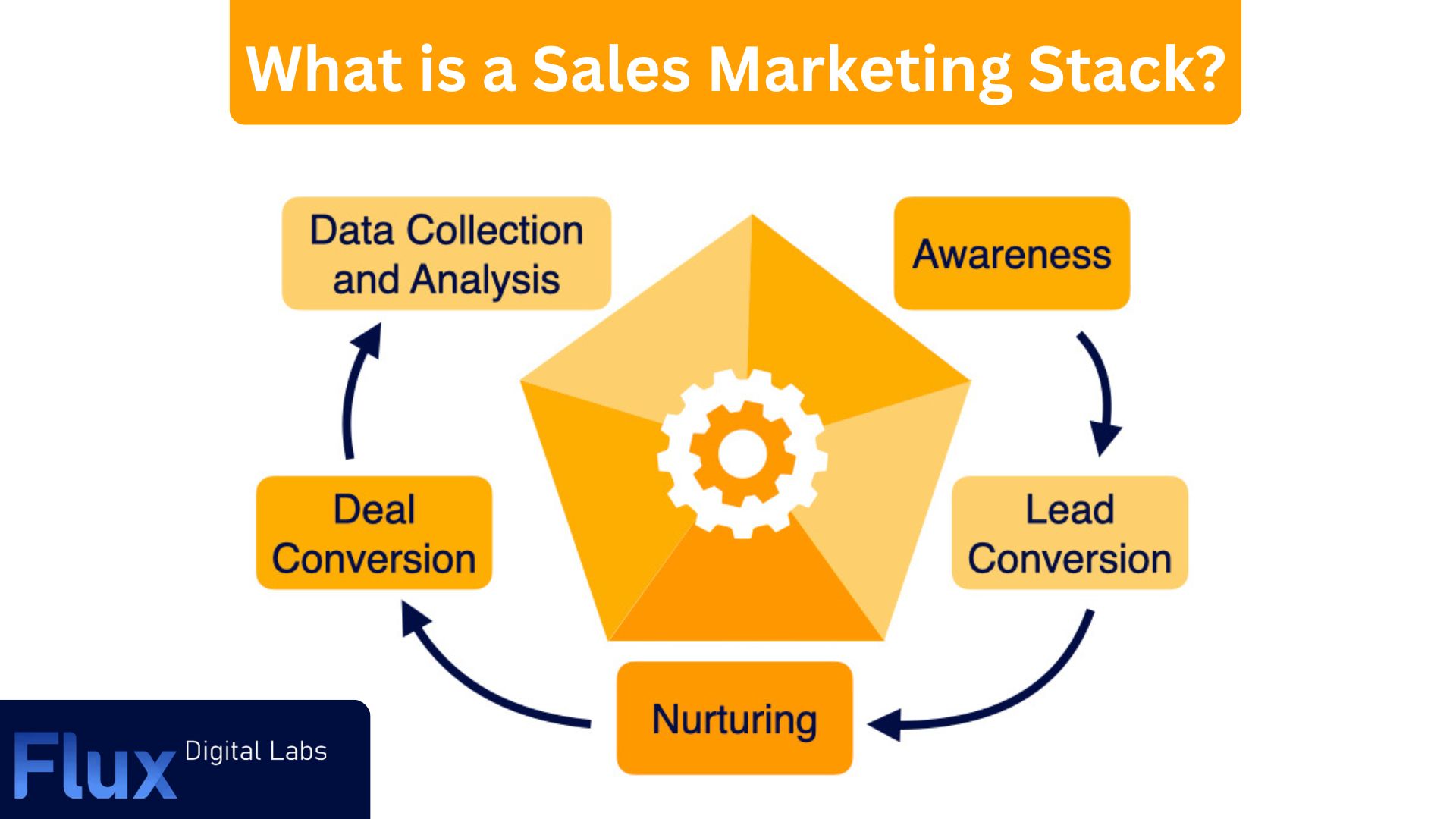
A martech stack (short for marketing technology stack) is a collection of tools and platforms that marketers use to plan, execute, and measure campaigns.
Think of it less like a single tool and more like an ecosystem, where each platform plays a role, and the real value comes from how they work together.
Instead of juggling disconnected tools, a well-designed martech stack connects your data, automates workflows, and gives you a clearer picture of performance.
How is a Martech Stack different from a Tech Stack?
A tech stack and a martech stack are closely related but serve different purposes. A tech stack refers to the full set of technologies used to build and run a product or digital service. This includes things like front-end frameworks, back-end systems, and infrastructure. Whereas a martech stack is specifically focused on marketing activities such as campaign execution, customer data management, and performance tracking.
A Tech Stack and a Martech Stack are similar in that both rely on integrated tools and data flowing between systems, and in many organisations they overlap. For example, a CMS like WordPress or analytics tools like Google Analytics can sit within both. The key difference is scope: the tech stack supports the entire product and engineering ecosystem, while the martech stack is a subset designed to help marketing teams attract, engage, and convert customers more effectively.
What Problems does a Martech Stack Solve?
Before diving into tools, let’s ground this in real-world situations.
Leads Are Coming In… But Going Nowhere
If leads from forms or ads sit in inboxes or spreadsheets, with inconsistent follow-up, you are missing a central system to capture and manage them.
Tools like Salesforce CRM or HubSpot ensure every lead is tracked and nurtured automatically.
Remember, what happens after leads arrive is just as important as getting the leads.
You Have Data Everywhere, But No Insight
If your ads platform, website analytics, and email tool all report different numbers., you are missing a unified view of performance.
Platforms like Google Analytics and Tableau help bring data together into meaningful insights.
Remember, if your data lives in silos, your decisions do too.
Marketing Feels Manual and Hard to Scale
If your team is stuck copying data, sending one-off emails, and repeating tasks your business probably needs automation.
With tools like Customer.io or HubSpot, repetitive work becomes automated workflows.
Remember, if your marketing depends on copy-paste, it won’t scale.
You’re Spending Money… But Can’t Prove ROI
If budgets go into paid campaigns, but the results are unclear attribution and tracking is probably missing.
Combining Google Ads with analytics tools helps tie spend directly to outcomes.
Remember, if you can’t measure it, you can’t defend it.
Your Customer Experience Feels Disjointed
If your customers receive inconsistent messaging across channels, you are missing connected systems and shared data.
A strong stack creates a single customer view, enabling personalization at scale.
Remember, your customers see one brand, so your tools shouldn’t act like ten.
Core Components of a Martech Stack
Most martech stacks include a combination of the following:
1. Customer Relationship Management (CRM)
A CRM acts as the central hub for customer data.
- Example: Salesforce CRM, HubSpot CRM, Zoho CRM
- Stores leads, tracks interactions, and supports sales alignment
2. Marketing Automation
Automates campaigns, workflows, and lead nurturing.
- Example: HubSpot CRM, Customer.io and ActiveCampaign
- Sends emails, scores leads, and triggers actions based on behavior
3. Analytics & Reporting
Tracks user behavior and campaign performance.
- Example: Google Analytics
- Helps answer: What’s working? What isn’t?
4. Content Management System (CMS)
Manages your website and content.
- Example: WordPress, HubSpot CMS and Webflow
5. Advertising Platforms
Used to run and optimize paid campaigns.
- Example: Google Ads, Facebook Ads and LinkedIn Ads
6. Social Media Management
Schedules, publishes, and monitors social content.
- Example: Hootsuite
How a Martech Stack Works Together
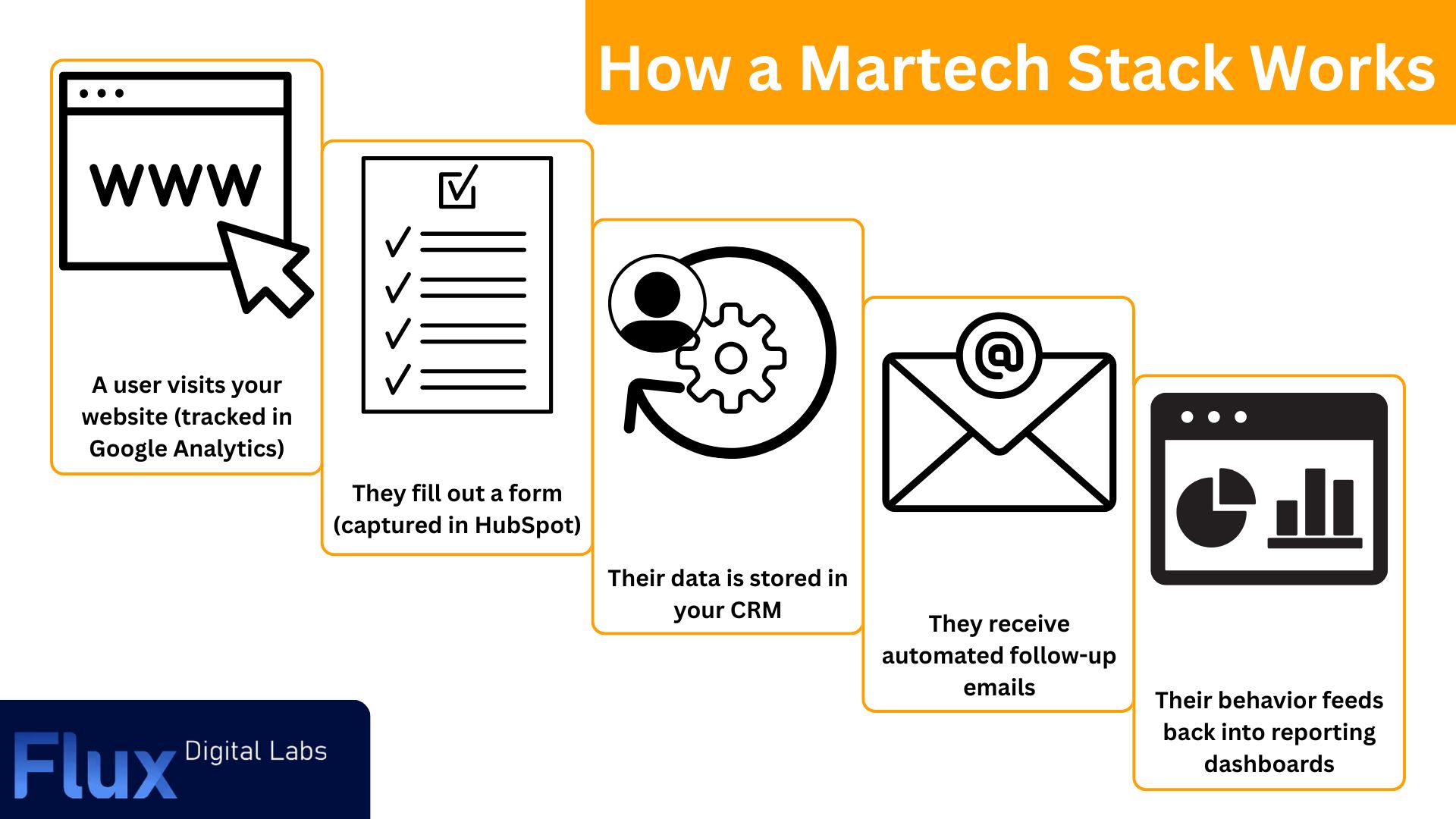
The real power of a martech stack isn’t in individual tools, it’s in how they connect. For example:
- A user visits your website (tracked in Google Analytics)
- They fill out a form (captured in HubSpot)
- Their data is stored in your CRM
- They receive automated follow-up emails
- Their behavior feeds back into reporting dashboards
This creates a continuous loop of data, action, and optimization.
Example Martech Stacks
Small Business Stack
- Mailchimp (email marketing)
- WordPress (website)
- Google Analytics (analytics)
Why it works: Simple, cost-effective, and easy to manage.
Mid-Sized Company Stack
- HubSpot (CRM + automation)
- SEMrush (SEO and research)
- Hootsuite (social media)
Why it works: Balances capability with usability.
Enterprise Stack
- Salesforce CRM
- Adobe Experience Cloud
- Tableau
Why it works: Highly customizable, built for scale and complexity.
Benefits of a Martech Stack
- Efficiency: Automation reduces manual work
- Clarity: Centralized data improves decision-making
- Personalization: Better customer insights enable targeted messaging
- Scalability: Systems grow with your business
Common Challenges
Even with the right tools, problems can arise:
- Too many tools (“stack bloat”)
- Poor integrations
- Data silos
- High costs
The goal isn’t to have more tools, it’s to have the right ones working together.
How to Build Your Martech Stack
- Start with your business goals
- Identify gaps (not just tools you want)
- Choose platforms that integrate well
- Keep it as simple as possible
- Evolve your stack over time
The Future of Martech
Martech continues to evolve rapidly, with trends like:
- AI-driven automation and insights
- Greater focus on first-party data
- Increasing privacy and compliance requirements
- Platform consolidation
A martech stack isn’t just a collection of tools, it’s the foundation of modern marketing.
If your team is struggling with scattered data, manual processes, or unclear performance, the issue may not be effort, it may be structure.
Because in the end:
Better marketing doesn’t come from doing more.
It comes from building systems that work together.