
For RevOps teams, lead scoring isn’t a theoretical framework; it’s production infrastructure. When it works, the pipeline moves faster, SLAs are met, and sales trusts inbound. When it doesn’t, leads are rejected, follow-ups are stalled, and lead quality is debated.
At the heart of this problem is a fundamental question:
Should leads be scored based on who they are, or what they do?
Treating behavioral and demographic scoring as interchangeable signals, rather than distinct operational inputs, is a common mistake.
This article breaks down how each scoring dimension works, where it fails in isolation, and how RevOps teams can balance them, using clear frameworks and measurable KPIs, to drive predictable pipeline outcomes.
Demographic Lead Scoring: Fit-Based Scoring
Demographic (and firmographic) scoring is how RevOps operationalizes the Ideal Customer Profile. Its job is not urgency, it’s eligibility.
Common Fit Signals
- Job title, seniority, and role taxonomy
- Department or buying function
- Company size and revenue bands
- Industry or vertical alignment
- Geographic eligibility
- Technology stack compatibility
These attributes typically come from form data, enrichment providers, and CRM normalization rules.
Why Demographic Scoring Matters Operationally
- Protects sales capacity from poor-fit leads
- Enables consistent segmentation across teams
- Anchors routing logic and territory models
- Correlates strongly with deal size and retention
Where It Breaks Down
- Fit does not imply readiness
- High-fit leads can linger indefinitely without intent
- Over-scoring titles without buying context inflates expectations
RevOps reality: Demographic scoring defines who belongs in the pipeline, not when to engage.
Example: A VP of Marketing at a 500-person SaaS company may look perfect on paper, but if they’ve never engaged with your product, they’re unlikely to convert right now.
RevOps KPIs for Demographic (Fit-Based) Scoring
Demographic scoring should be evaluated based on pipeline quality and efficiency, rather than volume.
Key KPIs to Track
- Sales Acceptance Rate (SAL%) by Fit Tier
High-fit leads should be accepted at materially higher rates. - SQL Conversion Rate by Fit Score
Confirms whether fit predicts qualification. - Pipeline Value per Lead (by Fit Segment)
Validates that scoring aligns with revenue potential. - Disqualification Rate for High-Fit Leads
A warning sign of inflated or misaligned criteria. - Average Deal Size by Fit Tier
One of the strongest validators of fit accuracy.
If these KPIs underperform, the issue is almost always ICP definition, enrichment quality, or scoring thresholds.
Learn more about defining your Ideal Customer Profile (ICP)
Behavioral Lead Scoring: Measuring Buying Signals in Motion
Behavioral scoring is designed to capture intent, specifically how actively and recently a lead is engaging with buying signals.
Common Behavioral Inputs
- Visits to pricing, product, or integrations pages
- Content downloads and depth of engagement
- Email open and click behavior
- Webinar or event participation
- Demo requests or product trials
Unlike demographic data, behavioral signals are volatile and time-bound.
Why Behavioral Scoring Is Critical
- Enables fast response to in-market leads
- Improves speed-to-lead and SLA compliance
- Powers event-driven workflows
- Aligns marketing engagement with sales action
Where It Breaks Down
- Engagement ≠ qualification
- Poor-fit personas can dominate activity
- Without decay, old intent pollutes prioritization
RevOps reality: Behavioral scoring governs when to act, not who should own the lead.
Example: A student or consultant repeatedly downloading gated content may rack up a high behavioral score, despite having no buying authority.
RevOps KPIs for Behavioral (Intent-Based) Scoring
Behavioral scoring should be measured on speed, responsiveness, and short-term conversion.
Key KPIs to Track
- Speed-to-Lead by Intent Tier
High-intent leads should trigger the fastest response times. - Contact Rate for High-Intent Leads
Low rates can indicate false-positive intent signals. - MQL → SQL Conversion Rate by Intent Score
Validates whether engagement predicts readiness. - Lead Aging in High-Intent States
Flags SLA or routing breakdowns. - Opportunity Creation Within X Days of Intent Spike
Measures whether intent is operationally actionable.
If these metrics lag, the issue is usually signal weighting, decay logic, or workflow execution, not lead volume.
Don’t Forget Score Decay
Behavioral scores should decay as actions age. A pricing page visit from six months ago shouldn’t carry the same weight as one from yesterday.
The Core Tradeoff: Fit vs. Intent
Demographic and behavioral scoring answer two different, but equally important, questions:
- Demographic scoring: Should we sell to this lead?
- Behavioral scoring: Should we sell to this lead now?
Problems arise when teams rely too heavily on one dimension:
- Behavior-only models flood sales with active but unqualified leads
- Demographic-only models surface great-fit leads who aren’t ready to talk
Lead scoring works best as a two-dimensional model, not a single number.
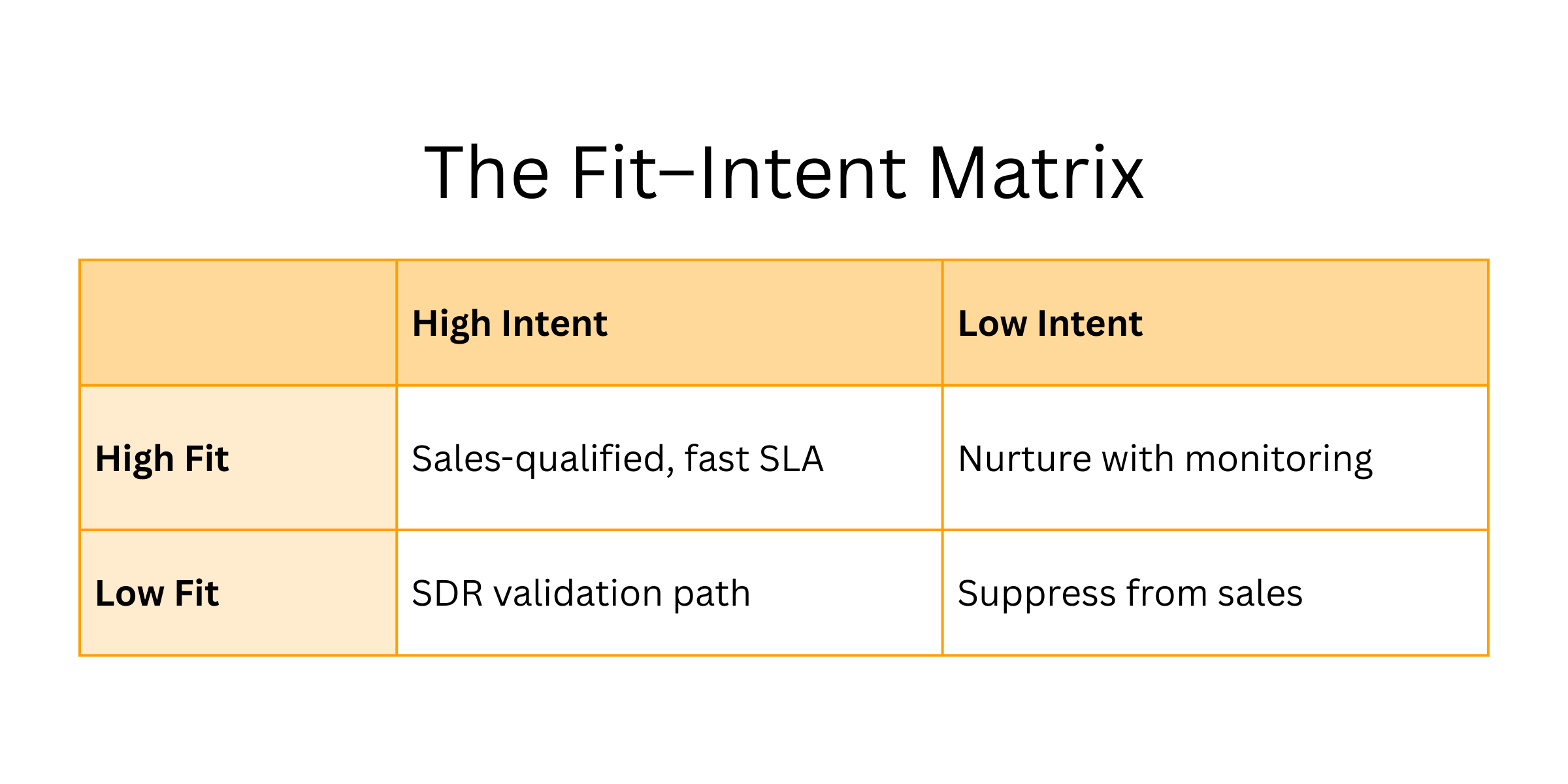
The Fit–Intent Matrix: A Model RevOps Can Operate and Govern
High-performing RevOps teams model scoring as two parallel dimensions.
The Fit–Intent Matrix
Operational Outcomes
- High Fit + High Intent → Route directly to AEs (Account Executives) with SLAs (Service Level Agreements)
- High Fit + Low Intent → Keep in nurture with alert triggers
- Low Fit + High Intent → Route to SDR (Sales Development Representative) queues for validation
- Low Fit + Low Intent → Exclude from sales workflows
This structure simplifies routing, clarifies ownership, and restores sales trust.
KPIs That Validate the Balance Between Fit and Intent
To evaluate the combined model, RevOps should track:
- Pipeline Conversion Rate by Fit–Intent Quadrant
- SLA Compliance for High Fit + High Intent Leads
- Revenue per Lead by Quadrant
- Sales Rejection Reasons and Feedback Trends
These KPIs confirm whether prioritization aligns with actual revenue impact.
Real-World Example: Same Score, Very Different Leads
Consider two leads, each with a total score of 85:
- Lead A
- Director-level role at a target company
- Minimal engagement
- Lead B
- Junior role at a non-target company
- Heavy website and content activity
In a single-score system, these leads look identical. In a fit–intent model, they’re clearly not.
This distinction is critical for maintaining sales trust in your scoring system.
Scoring Alone Doesn’t Drive Revenue, Execution Does
Lead scoring is an input, not an outcome.
Once scoring logic is defined and governed, it must feed directly into execution systems.
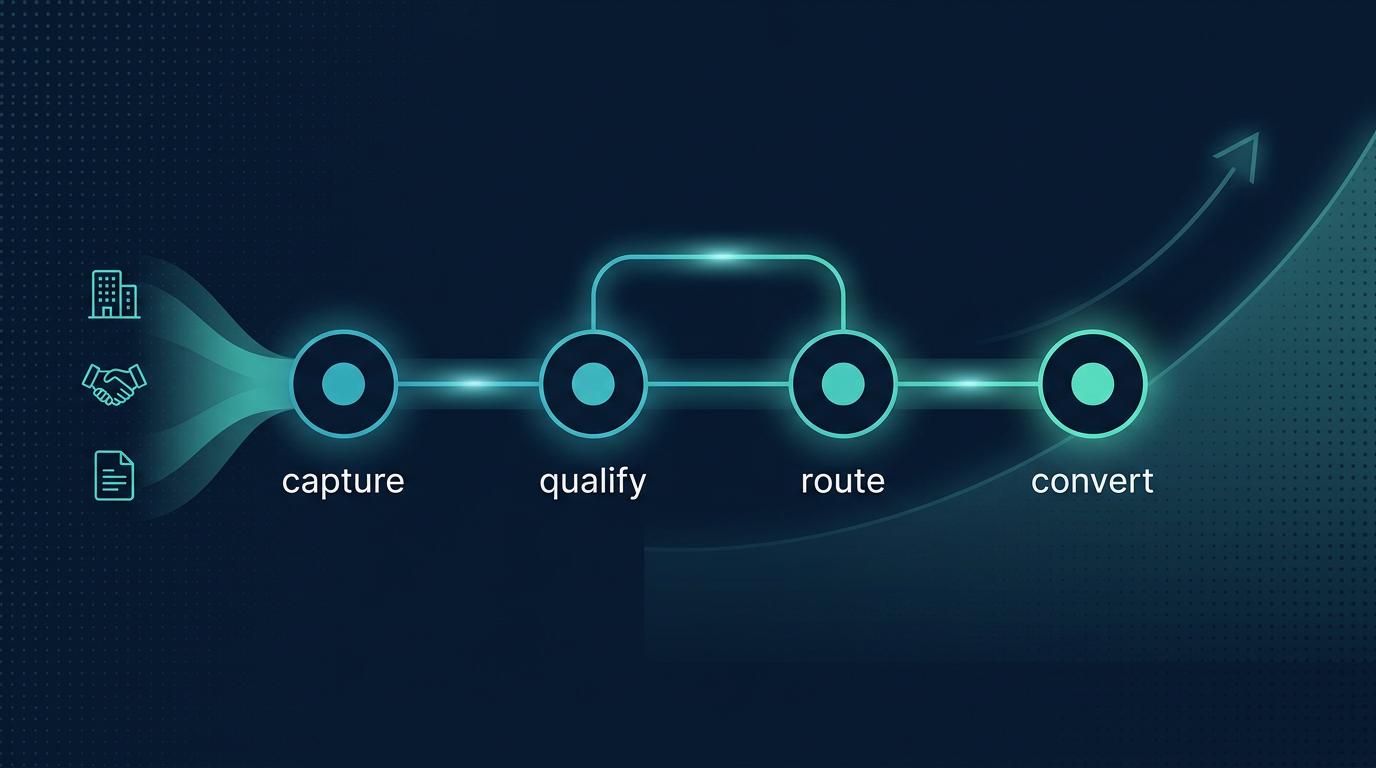
As a reminder: Once you’ve identified top-scoring leads, routing ensures they reach the right rep.
When scoring and lead routing are designed together, RevOps can:
- Align fit with territories and segments
- Match lead value to rep seniority
- Enforce SLAs automatically
- Eliminate manual reassignment and exceptions
This is where scoring becomes a true revenue infrastructure.
Common Mistakes to Avoid
Even well-designed scoring models fail when teams:
- Treat lead scoring as a one-time setup
- Ignore feedback from sales
- Over-optimize for historical data without ongoing validation
- Let marketing and sales define scoring in isolation
Effective lead scoring is a living system, not a static spreadsheet.
Final Takeaway: Separate Signals, Measure Outcomes, Align Systems
There is no universal ratio of behavioral to demographic scoring. The right mix depends on sales motion, deal size, and market maturity.
What is universal is the principle: Great lead scoring balances who a lead is with when they’re ready to buy.
What is universal for RevOps:
- Demographic scoring defines who belongs in the pipeline
- Behavioral scoring defines when to act
- KPIs ensure the system behaves as intended
- Routing turns insight into execution
Get those elements aligned, and lead scoring stops being a recurring ops problem and becomes a durable competitive advantage.