

Lead management complexity grows faster than most revenue teams anticipate as their business scales. Manual triage, basic scoring rules, or simple round-robin assignment used to work, but now they quickly break under increased volume, multiple buyer personas, and expanding sales teams.
This results in high-intent leads slipping through the cracks, sales teams losing confidence in marketing-sourced pipelines, and leadership lacking clarity on what’s truly driving revenue.
This guide is designed for decision-makers who are ready to move beyond patchwork solutions. We’ll walk through how to implement a scalable lead scoring and routing framework, one that brings structure, speed, and confidence to your revenue engine.
Why Lead Chaos Is a Growth Risk
Lead chaos rarely announces itself directly. Instead, it shows up as downstream inefficiencies:
- Sales follow-up times stretch from minutes to days
- High-quality leads are routed to the wrong reps, or not routed at all
- Marketing and sales teams disagree on what “qualified” actually means
- Reporting becomes unreliable, eroding trust at the leadership level
At the heart of the issue is fragmentation. Lead scoring is often treated as a marketing exercise, while routing is viewed as a sales operations problem. When these systems operate independently, even well-designed processes fail to scale.
Discover why it is important to have robust systems for qualifying leads.
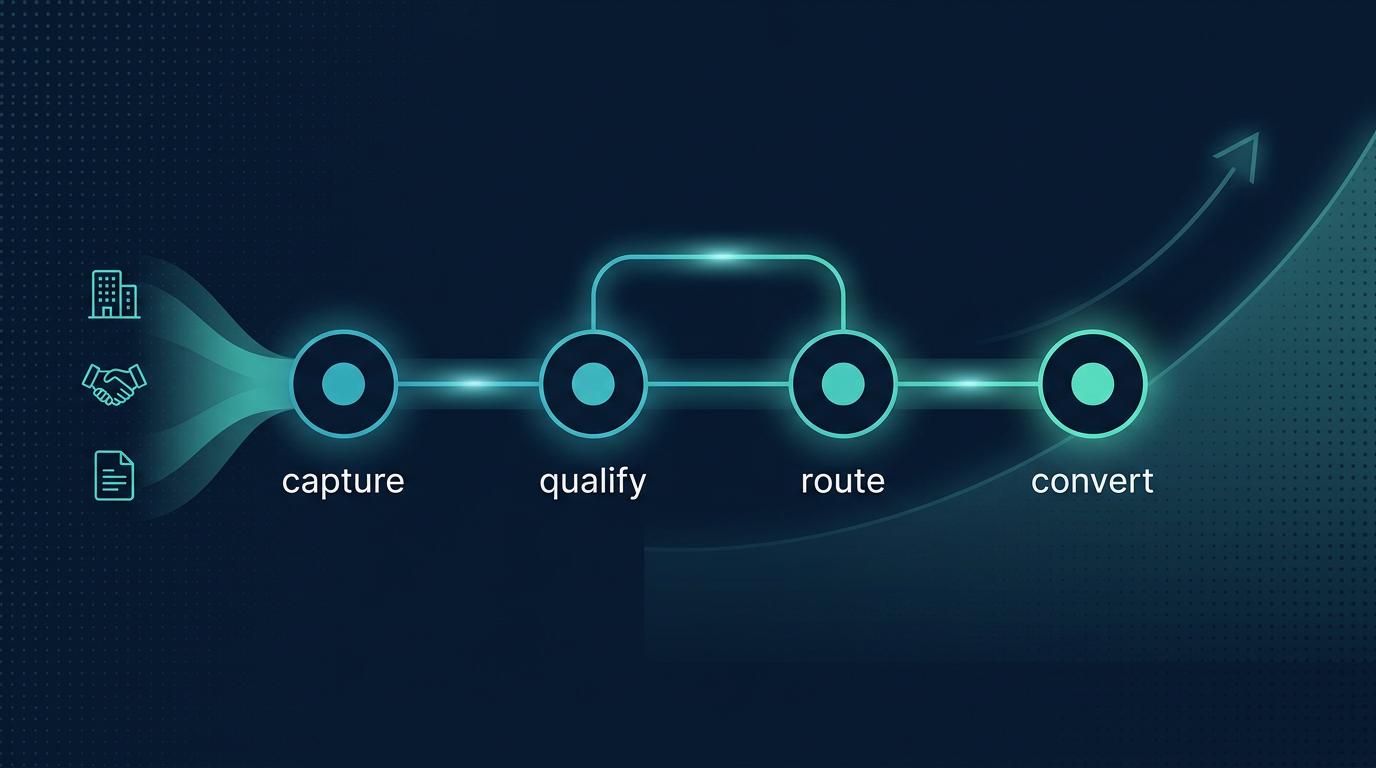
Clarity comes when scoring and routing are designed as a single, connected framework.
The Strategic Case for an Integrated Scoring & Routing Framework
Lead scoring and lead routing are not separate optimisations; they are two halves of the same operational system.
A scoring model determines priority. Routing determines action. Without alignment between the two, teams are left guessing which leads matter and what should happen next.
For leadership teams, an integrated framework delivers measurable outcomes:
- Faster speed-to-lead for high-intent prospects
- Higher sales acceptance and conversion rates
- Better capacity planning and forecasting accuracy
- Increased confidence in revenue attribution
Most importantly, it replaces reactive lead handling with a repeatable, scalable system that supports growth rather than constraining it.
Step 1: Define What a “Qualified Lead” Means for Your Business
Before technology or automation comes strategy.
A scalable framework starts with a shared definition of qualification, one that aligns marketing, sales, and revenue operations around a single source of truth.
This typically involves:
- Clarifying your Ideal Customer Profile (ICP)
- Distinguishing between inquiry, MQL, SQL, and opportunity stages
- Identifying the buying signals that genuinely correlate with revenue
The most effective teams resist the urge to over-engineer early. Instead, they prioritise clarity and alignment over complexity, knowing the model will evolve as data matures.
Governance is critical at this stage. Ownership of scoring and routing logic should be clearly defined to avoid ad-hoc changes that undermine system integrity over time.
Learn more about qualifying leads.
Step 2: Build a Scoring Model That Reflects Real Buying Intent
An effective lead scoring model balances simplicity with insight. It should be easy to interpret, grounded in real buyer behaviour, and directly tied to sales outcomes.
Core Scoring Dimensions
Explicit data
Firmographic and demographic attributes, such as company size, industry, role, and region, help determine fit.
Implicit data
Behavioural signals such as page visits, form submissions, content engagement, and intent indicators. These help determine readiness.
Negative scoring
Disqualifying behaviours or attributes (e.g. students, competitors, low-value regions) that reduce noise and protect sales capacity.
Scoring weights should reflect revenue impact, not surface-level engagement. A demo request from an ICP account should outweigh multiple content downloads from a poor-fit lead.
As volume and complexity increase, predictive or AI-assisted scoring can be introduced, but only once foundational data hygiene and alignment are in place.
Step 3: Design Routing Logic That Matches Buyer Urgency and Sales Capacity
Routing is where strategy meets execution.
Modern routing frameworks go well beyond simple geography or round-robin assignment. Instead, they account for:
- Lead score thresholds and urgency
- Account ownership and expansion opportunities
- Sales rep expertise, vertical focus, or product specialisation
- Capacity and fairness across teams
High-intent leads should trigger immediate, direct routing. Lower-intent leads may enter nurture, pooled queues, or inside sales teams until readiness increases.
Well-designed routing logic also includes exception handling, fallbacks that prevent leads from stalling due to system edge cases or ownership conflicts.
Step 4: Connect Scoring and Routing for Real-Time Execution
The real power of a scalable framework emerges when scoring and routing are tightly connected.
As a lead’s score changes, routing decisions should update automatically. Behavioural signals, enrichment data, and lifecycle changes must flow seamlessly between marketing automation and CRM systems, without manual intervention.
This integration ensures:
- High-intent leads are acted on immediately
- Sales teams trust the prioritisation they receive
- Marketing gains visibility into downstream outcomes
Step 5: Operationalise, Monitor, and Optimise
Implementation is only the beginning.
To ensure long-term success, leadership teams should track a defined set of metrics:
- Speed-to-lead by score band
- Sales acceptance and conversion rates
- Pipeline contribution by lead source and score
- Rep feedback on lead quality
Quarterly reviews allow teams to adjust weights, thresholds, and routing logic based on real performance, without constant disruption.
Equally important is change management. Clear documentation, training, and communication help ensure adoption across marketing, sales, and RevOps teams.
Common Pitfalls That Undermine Scoring & Routing at Scale
Even mature organisations fall into predictable traps:
- Treating scoring as a “set-and-forget” initiative
- Introducing excessive complexity too early
- Ignoring data quality and enrichment gaps
- Lacking clear ownership for system governance
Avoiding these pitfalls requires discipline, cross-functional alignment, and a willingness to revisit assumptions as the business evolves.
When to Rebuild vs. Refine Your Existing Framework
Not every organisation needs a complete overhaul.
Refinement may be sufficient if:
- Core definitions are aligned
- Data quality is strong
- Bottlenecks are isolated
A rebuild is often necessary when:
- Scoring and routing were built independently
- Sales distrusts marketing-generated leads
- Manual workarounds have become the norm
Delaying change carries its own cost, missed opportunities, inefficient teams, and slower growth.
From Chaos to a Scalable Revenue Engine
Lead chaos is not a technology problem; it’s a systems problem.
By unifying lead scoring and routing into a single, strategic framework, organisations gain clarity, speed, and confidence across their revenue operations. The result is not just better lead management, but a scalable engine that supports growth at every stage.
For decision-makers ready to move beyond fragmented processes, an integrated approach is no longer optional; it’s foundational.