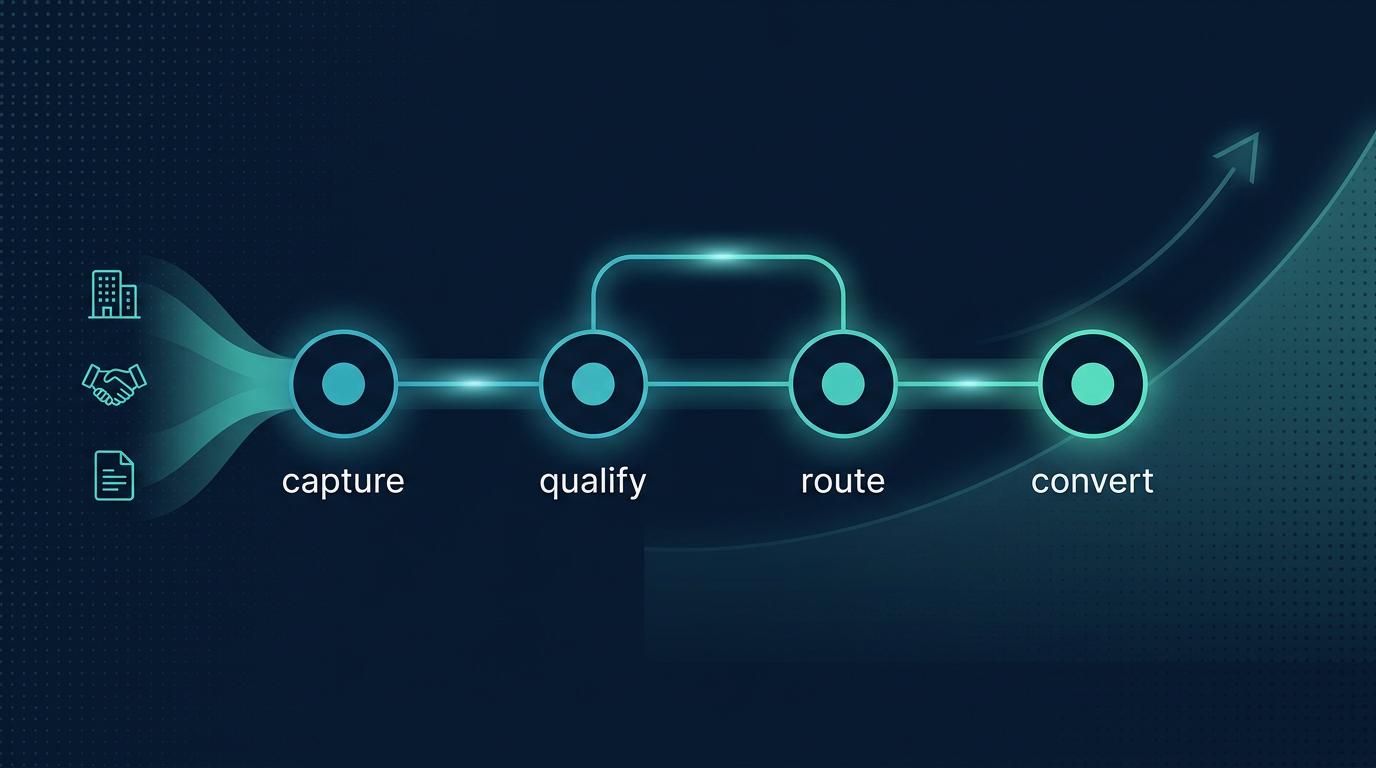

Most pipelines don’t suffer from a lack of leads, they suffer from a lack of qualified ones.
Marketing teams generate engagement. Sales teams chase conversations. But somewhere between a webinar signup and a sales call, many organisations struggle to separate genuine buying intent from casual interest.
The outcome is often predictable - wasted sales effort, bloated pipelines, longer deal cycles, and missed revenue opportunities.
For modern revenue teams, qualification is no longer just about ticking off a basic checklist. Today’s buyers leave behind a much richer set of signals, through their behaviour, questions, urgency, stakeholder involvement, and willingness to share context.
The challenge is identifying those signals early enough to prioritise the right opportunities.
In this article, we’ll explore the 15 strongest indicators that a lead is actually qualified, along with how modern martech strategies can help teams identify, score, and act on these signals more effectively.
What Makes a Lead “Qualified”?
A qualified lead is not someone who downloaded a whitepaper or attended a webinar.
Engagement alone doesn’t necessarily indicate buying intent.
A truly qualified lead is typically:
- Experiencing a meaningful business problem
- Motivated to solve it
- Capable of purchasing a solution
- Progressing toward a decision
That’s why modern qualification has evolved beyond static lead scoring models and surface-level engagement metrics.
Revenue teams are increasingly shifting toward:
- Behaviour-based qualification
- Intent-driven scoring
- Multi-touch engagement analysis
- Conversational intelligence
- Real-time pipeline insights
The goal is no longer to identify who is merely interested, it’s to identify who is genuinely moving toward a purchasing decision. Read our guide to lead scoring.
Here are the 15 signals that most consistently indicate a lead is actually qualified.
1. They Initiated the Conversation
One of the strongest qualification signals is when the prospect makes the first move.
Inbound actions such as:
- Requesting a demo
- Reaching out directly
- Visiting high-intent pages repeatedly
- Asking for pricing information
- Engaging with product-specific content
…often indicate active problem awareness and stronger buying intent.
Outbound prospecting still plays an important role, but self-initiated engagement usually signals that the buyer is already searching for a solution.
This is where intent tracking becomes especially valuable. Modern martech platforms can identify which accounts are actively researching relevant topics, revisiting key pages, or increasing engagement over time. This allows teams to prioritise high-intent opportunities earlier in the buying journey.
2. They Clearly Articulate the Problem
Qualified buyers can usually explain what’s wrong.
Instead of vague statements like:
“We’re exploring options.”
They say things like:
“Our lead routing process is slowing response times and hurting conversion rates.”
Specificity matters.
When a prospect can clearly define:
- The problem
- The operational impact
- The desired outcome
…it often reflects stronger internal alignment and a more mature buying process.
Clarity also helps sales and marketing teams position solutions more effectively because the conversation quickly shifts from education to problem-solving.
3. The Problem Is Causing Real Pain
Not all problems create urgency.
Qualified opportunities are typically tied to measurable business impact, such as:
- Revenue leakage
- Rising acquisition costs
- Poor conversion performance
- Operational inefficiencies
- Slow reporting processes
- Lost productivity
- Missed growth targets
When a problem starts affecting revenue, scalability, efficiency, or competitive positioning, organisations become far more motivated to act.
Pain creates urgency and urgency drives buying behaviour.
This is why effective qualification focuses on business consequences, not just technical requirements.
4. They Have Tried to Solve the Problem Already
A prospect who has already attempted to fix the issue is often much further along in the buying journey.
They may have:
- Tested other platforms
- Built internal workarounds
- Hired agencies or consultants
- Added temporary processes
- Invested in disconnected tools
This is an important signal because it demonstrates:
- Existing awareness of the problem
- Organisational recognition
- Some level of budget readiness
- Motivation to find a sustainable solution
By the time buyers begin evaluating alternatives seriously, they’re often looking for a more scalable or strategic answer to an ongoing challenge.
5. There Is a Defined Timeline
Qualified opportunities usually have a deadline attached to them.
Common examples include:
- Upcoming campaigns
- Quarterly targets
- Contract renewals
- Leadership mandates
- Budget cycles
- Product launches
There’s a significant difference between:
“We’re researching for next year.”
…and:
“We need this implemented before Q4.”
Defined timelines create momentum and indicate that the problem has become a business priority.
For sales teams, understanding timing is critical because urgency directly influences deal velocity and forecasting accuracy.
6. Budget Exists or Is Being Allocated
Budget conversations are rarely perfect predictors of deal quality, but they are still important signals.
A qualified buyer may not always have fully approved spending immediately available. However, serious opportunities often involve:
- Active budget discussions
- Procurement planning
- Resource allocation conversations
- Executive sponsorship
- Reprioritisation of existing spend
Modern qualification processes increasingly move beyond rigid frameworks that treat budget as a simple yes-or-no question.
Instead, they focus on overall purchasing readiness and organisational commitment to solving the problem.
7. The Right Stakeholders Are Involved
Complex B2B purchases rarely involve just one person.
As deals progress, qualified opportunities typically expand to include:
- Marketing leadership
- Sales operations
- IT and security teams
- Procurement
- Finance stakeholders
- Executive sponsors
This is one of the clearest indicators that internal evaluation is becoming serious.
Multi-threaded engagement reduces the risk of stalled deals because it demonstrates broader organisational buy-in and cross-functional alignment.
For revenue teams, visibility into account-wide engagement is becoming increasingly important for identifying genuine buying momentum.
8. They Ask Detailed Questions
The quality of a prospect’s questions often reveals the quality of the opportunity.
Highly qualified buyers tend to ask detailed, practical questions around:
- Integrations
- Security requirements
- Reporting capabilities
- Scalability
- Implementation timelines
- Migration processes
- Team adoption
These questions typically indicate active evaluation rather than passive curiosity.
In many cases, detailed questioning reflects internal preparation. This means the buyer is already thinking about implementation, rollout, and long-term usage.
9. They Share Internal Context
Trust is a major qualification signal.
When prospects begin sharing internal information such as:
- Team structures
- Existing workflows
- Technology stack details
- Internal blockers
- KPIs and performance metrics
- Decision-making processes
…it often indicates serious buying intent.
Buyers generally don’t reveal operational details unless they believe the conversation could lead to a viable solution.
This is where conversational intelligence and CRM enrichment become especially valuable. Capturing and centralising these insights helps teams improve qualification accuracy while reducing reliance on manual note-taking and fragmented data.
10. They Respond Quickly
Responsiveness is often a strong indicator of momentum.
Qualified buyers tend to:
- Reply quickly to emails
- Schedule meetings promptly
- Maintain engagement between conversations
- Follow through on requested actions
While fast responses alone don’t guarantee qualification, they become highly meaningful when combined with other intent signals.
Slow communication often reflects low prioritisation internally. Fast communication usually signals active evaluation and urgency.
11. They Compare Alternatives
When prospects begin comparing vendors, they’re usually no longer deciding whether to solve the problem. They’re deciding how.
This often includes:
- Competitor comparisons
- Feature evaluations
- Pricing discussions
- Review research
- Requests for differentiation
At this stage, buyers are typically narrowing their shortlist and validating decision criteria.
For martech organisations, this is where positioning becomes critical. Teams that can clearly connect platform capabilities to measurable business outcomes are often better positioned to influence final decisions.
12. They Discuss Impact or ROI
Qualified buyers focus on outcomes, not just features.
Instead of asking:
“What does the platform do?”
They ask:
“How much time will this save our team?”
“How will this improve conversion rates?”
“What impact could this have on pipeline growth?”
ROI-oriented conversations are particularly important because they often indicate executive-level thinking and internal justification efforts.
As budgets become more scrutinised, buyers increasingly need measurable business cases before moving forward with purchasing decisions.
13. The Problem Aligns With Your Ideal Customer Profile
Not every interested lead is actually a good fit.
Strong qualification depends not only on intent, but also on alignment with your Ideal Customer Profile (ICP).
Key ICP considerations may include:
- Industry
- Company size
- Growth stage
- Technology maturity
- Existing stack
- Operational complexity
- Use case fit
A prospect may be highly engaged, but if the underlying fit is weak, long-term retention and customer success become much less likely.
This is why effective qualification combines behavioural signals with firmographic and contextual data.
Discover how to define your Ideal Customer Profile.
14. They Ask About Next Steps
Future-oriented questions are often clear indicators of buying progression.
Qualified buyers frequently ask:
- “What does onboarding look like?”
- “How long does implementation take?”
- “Can we involve procurement?”
- “What happens after the demo?”
- “Who would manage the rollout?”
These conversations suggest the buyer is mentally moving beyond evaluation and beginning to picture adoption.
Momentum matters. Buyers who actively discuss process and implementation are often much closer to making a decision.
15. They Introduce You to Internal Champions
One of the strongest qualification signals is internal advocacy.
This happens when someone inside the organisation:
- Recommends your solution internally
- Shares your materials with stakeholders
- Expands access to additional decision-makers
- Pushes conversations forward without prompting
Internal champions can dramatically accelerate deal progression because they help navigate internal politics, build consensus, and maintain momentum when sales teams aren’t in the room.
For revenue teams, identifying and enabling champions is often one of the most effective ways to improve conversion rates and shorten sales cycles.
Why Most Qualification Processes Fail
Despite having access to more data than ever before, many organisations still struggle with qualification accuracy.
Common problems include:
- Over-reliance on simplistic lead scores
- Disconnected sales and marketing systems
- Poor CRM hygiene
- Limited behavioural visibility
- Manual qualification processes
- Inconsistent definitions of “sales-ready”
One of the biggest mistakes revenue teams make is confusing activity with intent.
A lead may attend events, download resources, and engage with campaigns without having any meaningful urgency or purchasing readiness.
Without deeper visibility into behavioural signals and buyer context, pipelines quickly become inflated with low-probability opportunities.
Find out about Behavioural vs Demographic Scoring and Lead Scoring.
How Martech Improves Lead Qualification
Modern martech platforms help organisations move beyond reactive qualification and toward data-driven opportunity prioritisation.
This includes:
Intent Data
Identifying accounts actively researching relevant topics before they formally enter the pipeline.
Read From Lead Chaos to Clarity.
Behavioural Analytics
Understanding engagement quality rather than simply measuring volume.
Read Behavioural vs Demographic Lead Scoring
CRM and Automation Alignment
Ensuring sales and marketing teams work from unified qualification criteria and real-time data.
Read How to Align Sales and Marketing Around Lead Scores That Actually Convert
Conversational Intelligence
Capturing buying signals, objections, stakeholder insights, and qualification details automatically from meetings and communications.
Read How to Tell If Your Lead Scoring Model Is Working or Holding You Back
Predictive Scoring
Using behavioural, firmographic, and engagement data to prioritise accounts most likely to convert.
Read Lead Scoring: A Technical Guide to Identifying, Qualifying, and Activating High-Intent Leads
Together, these capabilities help revenue teams focus their effort where it matters most — improving efficiency, forecasting accuracy, and pipeline quality.
Summing Up
Qualified leads rarely appear by accident.
They reveal themselves through:
- Urgency
- Behaviour
- Stakeholder involvement
- Business impact
- Buying momentum
- Organisational alignment
The most effective revenue teams don’t rely on instinct alone. They build systems that consistently surface qualification signals early and help teams act on them with confidence.
As buying journeys become more complex, organisations that can accurately identify genuine intent, while filtering out low-quality opportunities, will gain a significant competitive advantage.
For modern martech teams, the goal is no longer simply generating more leads. It’s identifying the right ones sooner.