
If you run a mortgage brokerage, a real estate business, a staffing firm, or any other service business where deals are won or lost in conversations, lead management is the difference between a business that grows predictably and one that grows by accident.
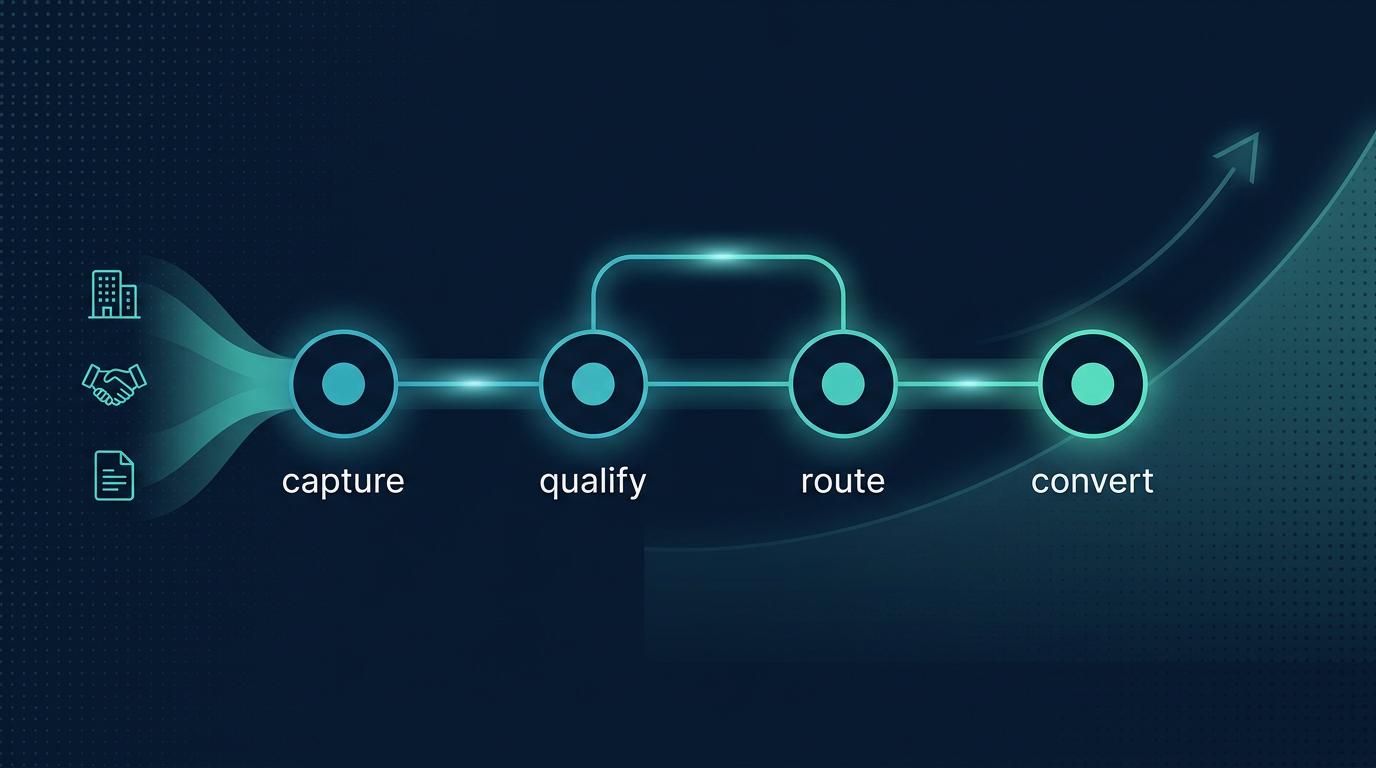
Most founders in this space think of lead management as a CRM problem. It isn't. It's a process problem that a CRM can support, if the process is right. What lead management actually means, in working terms, is this: every enquiry that comes into your business gets captured in one place, assessed against a consistent set of criteria, scored based on real buyer behaviour, sent to the right person at the right time, and followed up without depending on someone remembering to do it.
That's it. No textbook language. No software stack. A system that handles leads the same way every time, regardless of who's in the office.
This page is written for service business founders and sales leads, people managing teams of two to fifteen who are dealing with real enquiry volume and know something in the process is leaking. If you're running a SaaS company or managing an enterprise pipeline, this isn't written for you.
What Lead Management Actually Covers
Lead management has four working components. Not features, but components. Each one does a different job, and when any one of them fails, the whole system degrades.
- Lead capture is where it starts. Every enquiry, from every source (referral, web form, paid campaign, inbound call, broker network) needs to land in the same place in the same format. In most service businesses it doesn't. Some leads go to a shared inbox, some go to individual reps, some come in through a form that nobody checks consistently. The moment you have multiple capture points with no single source of truth, you have a lead management problem, even if everything else is functioning.
- Lead qualification is the process of determining whether an enquiry is actually worth working. For a mortgage broker, that might mean confirming employment status, loan size, and timeline. For a recruitment firm, it means understanding the role, the budget, and whether there's genuine urgency to hire. Qualification criteria aren't just useful for filtering. They're the mechanism by which you define what your business actually sells to, and who deserves your team's time. Without it, your reps are making individual judgment calls on every lead, and those calls will not be consistent.
- Lead scoring sits on top of qualification. Where qualification is a pass/fail gate, scoring is a ranking. Not all qualified leads are equally ready to buy, equally valuable, or equally likely to convert. Scoring models assign weight to behaviours, such as whether a person has booked a call, opened multiple emails, or returned to your site, and to fit criteria that map to your actual best clients. The purpose of a scoring model isn't to be clever. It's to tell your team where to spend time first.
- Lead routing is the mechanism that moves a qualified, scored lead to the right person without manual intervention. In a two-rep business, routing might mean an automated assignment based on geography or product type. In a ten-rep business, it might be more nuanced: round-robin within a team, weighted by capacity, triggered by a score threshold. The reason routing matters at the small business level is simple. When routing is manual, it depends on whoever is paying attention. That creates delays, inconsistency, and leads that fall through entirely.
None of these components are optional. They're sequential. A scoring model built on top of an inconsistent capture process will give you bad scores. Routing that fires before qualification criteria are defined will send the wrong leads to the wrong people. Build them in order.
Why Lead Management Breaks Down in Service Businesses Specifically
Service businesses have a failure mode that product businesses don't face in the same way. The sales process is personal, and personal processes don't scale.
When a mortgage broker is handling ten enquiries a week, a spreadsheet and a good memory can work. When that becomes forty enquiries a week, through referral growth, a paid campaign that starts working, or a partnership that delivers volume, the same approach breaks down completely. The enquiries don't slow down to wait for the system to catch up.
The most common failure isn't chaos. It's invisible leakage. Leads that were qualified but never scored. Leads that were scored but never routed. Leads that were routed but never followed up because the rep was busy and there was no automated sequence to catch the gap. None of these failures announce themselves. They show up three months later when conversion rate drops and nobody can explain why.
There are four specific places this breaks down in small service businesses.
High enquiry volume with a small team. When one or two people are handling all inbound, triage becomes informal. The leads that get attention are the ones that seem most urgent or most vocal, not necessarily the ones that score highest or represent the best fit. This isn't a people problem. It's what happens when volume exceeds the capacity of a manual process.
No defined qualification criteria. If you ask three reps what makes a good lead, you'll get three answers. That's not a sign of bad reps. It's a sign that qualification hasn't been formalised. Informal qualification produces inconsistent outcomes and makes it impossible to improve the process over time, because you don't actually know what the process is.
CRM used as a contact database. This is the single most common failure mode in service businesses. The CRM is live. Data is going in. But it's being used to store records, not to run a process. There are no stage gates, no qualification fields being enforced, no automated routing, no triggered sequences. It's a digital Rolodex. That's not a lead management system.
Follow-up that depends on the individual. If a lead gets followed up because a rep remembered to do it, your follow-up rate is a function of your team's memory and workload, not your process. When a rep is busy, follow-up drops. When a rep leaves, follow-up stops entirely for their contacts. The system needs to trigger follow-up. The rep executes it. That's the model.
One specialist financial intermediary came to us with exactly this combination of problems. They were processing 17 transactions per month and had real lead volume, as the demand was there. After rebuilding the lead management process from the ground up and automating the routing layer, that number became 87 transactions per month in nine months. The leads didn't change. The system changed.
The Lead Management System a Service Business Actually Needs
There's a version of this conversation that ends with a list of software recommendations. That's not what this is. The tools matter far less than the operational structure underneath them. Here's what a functioning lead management system looks like at the two-to-fifteen rep level.
- A single lead capture point feeding the CRM directly. Every channel (web forms, inbound calls, referral submissions, paid campaign landing pages) routes to the CRM automatically, without a human step in between. The data format is consistent. The fields are standardised. Nothing arrives in an inbox and gets manually transferred later.
- ualification criteria defined and enforced at entry. The fields that determine whether a lead is qualified are required fields in the CRM. You cannot move a lead past the initial stage without completing them. This isn't about being rigid. It's about ensuring that every rep is making qualification decisions based on the same information. If the criteria need to evolve, you update the fields. The process stays consistent.
- A scoring model that reflects actual buyer behaviour. The best scoring models are built backwards from your existing closed clients. What did they do before they converted? What signals appeared in the first 48 hours? What fit criteria were consistent across your highest-value deals? Behaviour gets weighted more heavily than demographics, because behaviour is a leading indicator. Someone who has visited your pricing page three times and opened four emails is more ready than someone who matches your ICP perfectly but went cold after the first enquiry.
- Automated routing. Once a lead crosses a qualification threshold or hits a score trigger, it moves automatically. The right rep gets notified. The lead is assigned. No one has to look at a queue and make a decision. In a small team, this can be as simple as a rule-based assignment. In a more complex operation, it might involve capacity balancing or product-based routing. The point is that routing happens without human intervention at every step.
- Follow-up sequences that trigger without manual intervention. A qualified lead that doesn't hear from you within a defined window should receive an automated touchpoint, not a generic email, but a message that reflects where they are in the process. A sequence for a new enquiry looks different from a sequence for a lead that went quiet after a discovery call. These sequences aren't replacements for personal follow-up. They're the safety net that ensures nothing goes dark because someone was busy.
- Reporting that shows conversion rate at each stage. You need to see where leads are dropping out of the process. Not just overall conversion, but stage by stage. If 60% of your leads are qualifying but only 20% are making it to a discovery call, the problem is in the gap between qualification and outreach. That's a routing or response-time problem. If qualification rates are low, that's either a traffic quality problem or a criteria problem. The reporting tells you where to fix.
Lead Management by Sector
The principles are the same across every service business. The application changes depending on how your buyers make decisions and what your sales cycle actually looks like.
Financial services: mortgage brokers, wealth advisers, insurance brokers. In financial services, the gap between enquiry and engagement is short, but the qualification bar is high. A mortgage broker can't spend two hours with a lead who isn't finance-ready. Qualification criteria here need to capture loan size, employment type, LVR, and urgency, and they need to be captured at intake, not discovered on a discovery call. Scoring should weight recency and engagement heavily, because a financial services lead that goes cold for two weeks often converts with a competitor. Routing in larger brokerage operations should account for broker specialisation (residential versus commercial, first home buyers versus investors) rather than assigning leads round-robin.
Real estate. Real estate businesses deal with a wide range of buyer readiness. Someone who just started browsing and someone who has sold their home and needs to move in 60 days are both leads, but they require completely different handling. Qualification criteria need to separate active buyers from passive ones, and scoring models should weight behavioural signals like property page views, saved listings, and repeat visits heavily. Routing in real estate often needs to account for geography and property type. The biggest failure mode here is treating all enquiries the same and burning agent time on leads that are twelve months away from transacting.
1031 Qualified Intermediaries. This is one of the most time-sensitive niches in financial services. A 1031 exchange has hard legal deadlines: 45 days to identify replacement property and 180 days to close. A lead that isn't engaged within hours of enquiry may not be workable at all. Lead management for a QI firm needs to prioritise speed-to-contact above almost everything else, and the qualification criteria need to capture exchange type, timeline, and sale close date at first contact. Automated routing with immediate notification, rather than a daily lead review, is non-negotiable.
Staffing and recruitment. Staffing businesses manage two separate lead flows simultaneously: client-side and candidate-side. A lead management system for a recruitment firm needs to handle both, without conflating them. On the client side, qualification criteria should capture role type, timeline, budget range, and exclusivity. On the candidate side, qualification is about fit for active roles. The most common failure in recruitment firms is that both flows land in the same CRM pipeline with no differentiation in how they're managed, which creates confusion in reporting and in routing.
Common Lead Management Mistakes and How to Fix Them
These five mistakes appear consistently across service businesses at the two-to-fifteen rep level. They're worth naming directly because most of them are invisible until you're looking for them.
Scoring on demographics only, not behaviour. A scoring model that assigns points for job title, company size, and industry tells you what a lead looks like. It doesn't tell you what a lead is doing. Behaviour is a far more reliable indicator of conversion readiness. Fix this by auditing your last 50 closed deals and identifying what actions they took in the 30 days before converting. Weight your model accordingly.
No defined ICP so qualification is subjective. If your ideal client profile exists as a vague internal consensus rather than a documented set of criteria, qualification will vary by rep. This means your conversion data is polluted. You can't tell if a drop in conversion rate is a lead quality problem or a qualification consistency problem. Fix this by documenting your ICP as specific, binary attributes and building them into your qualification fields.
A scoring model that was never tested against real outcomes. Many businesses build a scoring model once, assign it to the CRM, and never revisit it. Six months later, high-scoring leads are converting at the same rate as low-scoring ones, and nobody questions the model. Fix this by running a quarterly comparison between lead score at entry and actual conversion outcome. If the correlation is weak, the model needs recalibration.
Sales and marketing using different lead definitions. Marketing calls a lead anyone who fills out a form. Sales calls a lead anyone who's had a discovery call. These definitions produce completely different pipeline numbers, and when both teams are reporting against their own definition, nobody can see the actual problem. Fix this by agreeing on a single taxonomy (enquiry, marketing qualified lead, sales qualified lead) and using it consistently across reporting.
Not knowing the cost of doing nothing. Most founders treat a broken lead management system as an operational inconvenience. It isn't. If your current process converts leads at 18% and a well-functioning system would convert at 30%, the gap between those two numbers, multiplied by your monthly lead volume and average deal value, is what your current system is costing you every month. Calculate that number. It tends to make the case for fixing the process more clearly than anything else.
When to Build Your Lead Management System vs When to Fix It
This is a practical decision, and it depends on what you're actually starting from.
Build from scratch if:
- You have no CRM, or the CRM you have is largely unused
- You have no documented qualification criteria and decisions are made by feel
- Leads are currently managed in spreadsheets, shared inboxes, or individual email threads
- There is no consistent follow-up process and some leads get called back while others don't
In this situation, fixing what exists isn't possible because there isn't enough structure to fix. You need a clean build: defined process first, then tooling configured to support it.
Fix what exists if:
- Your CRM is live and data is going in, but adoption across the team is inconsistent
- You have a scoring model, but the scores don't seem to correlate with actual conversion
- Routing is happening manually even though your CRM technically supports automation
- Follow-up sequences exist in the system but aren't triggering correctly or aren't being used
In this situation, the foundation is there. The work is tightening the process, enforcing the criteria that already exist, and activating the automation your tool already supports.
The honest answer for most service businesses is that they're somewhere between the two. The CRM is live but the process underneath it was never properly designed. There's a scoring model but it was built by someone who set it up once and left. There's no clean line between build and fix. There's a diagnosis that tells you which parts need to be rebuilt and which parts need to be recalibrated.